
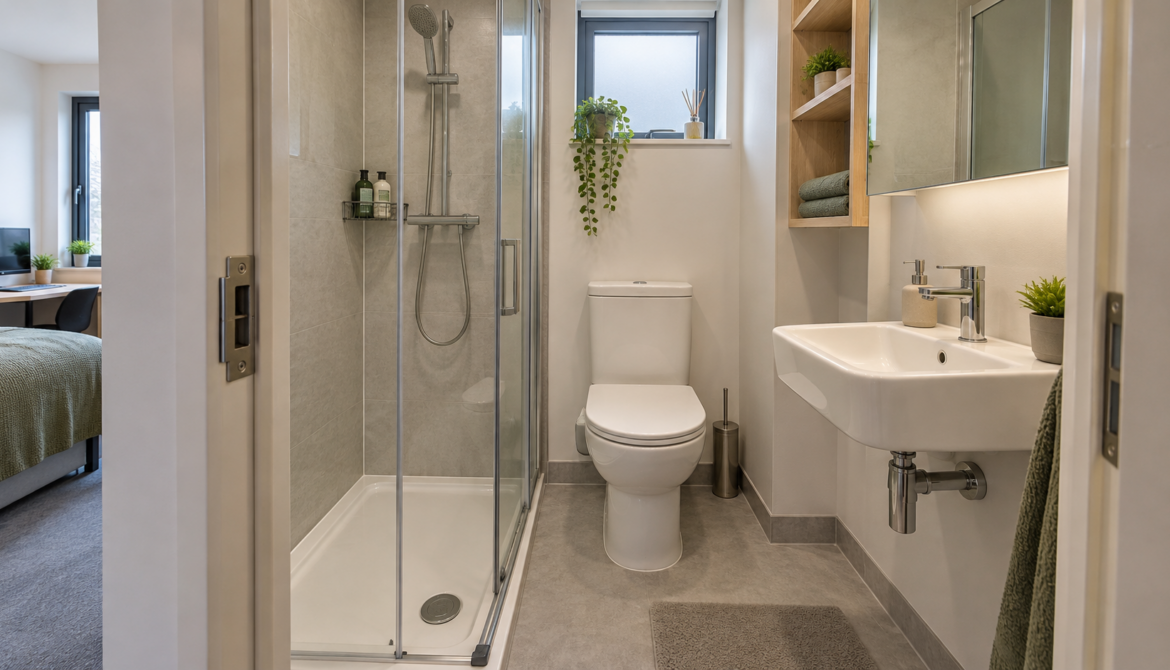
PBSA is housing designed, built, and managed exclusively for university students, with fully furnished rooms, all-inclusive utility bills and professional on-site management.
For developers, contractors and operators, PBSA bathroom planning starts with the room type, the number of individual users and the expected pattern of occupation. Bathrooms are commonly either private facilities within en-suite cluster flats or fully self-contained facilities within studios. In both cases, the bathroom is a core part of the resident experience and a repeated-use area throughout the academic tenancy.
PBSA tenancy contracts typically run from 44 to 51 weeks, matching the academic year. This creates a clear operational cycle: rooms and bathrooms are occupied during term time, then inspected, cleaned and prepared for the next intake. Bathroom specification therefore needs to account for regular use, access for maintenance and a defined annual turnover period.
What is PBSA?
PBSA provides accommodation exclusively for university students rather than the general residential market. It is designed, built and managed around student occupation, usually combining furnished bedrooms with communal or private living facilities, utilities included within the rent and professional on-site management.
The model is distinct from a conventional private rental because accommodation, services and management are planned as one operational offer. Building layouts may include shared social areas, reception or management spaces, laundry facilities and a mix of room types suited to different student preferences and budgets.
At room level, the choice between an en-suite cluster flat and a studio directly determines the bathroom arrangement. This affects the number of bathrooms required, whether kitchens are shared or private, and how bathroom components are repeated across the building.
For PBSA schemes using compact room footprints, bathroom pods for small spaces can be considered as part of the wider approach to bathroom standardisation and room planning.
En-Suite Cluster Flats vs. Studios — Bathroom Configuration by Room Type
En-suite cluster flats provide each student with a private bedroom and private bathroom. The kitchen and living area are shared with other residents within the flat. This configuration gives every occupant direct access to their own bathroom while retaining communal cooking and social space.
From a bathroom planning perspective, an en-suite cluster flat repeats a private bathroom across each bedroom in the cluster. The shared element is concentrated in the kitchen and living area, not in the bathroom. This makes bathroom consistency across bedrooms important when a scheme includes multiple clusters with the same room layout.
Studios are self-contained units with a private bathroom and private kitchenette. The resident does not share kitchen or living facilities with other students in the unit. The bathroom is therefore part of a complete individual living space alongside sleeping, study and cooking functions.
The two room types require different coordination priorities:
- En-suite cluster flats: private bathrooms are paired with shared kitchens and living areas.
- Studios: private bathrooms are paired with private kitchenettes inside self-contained units.
- Both configurations: each resident has a private bathroom, creating repeated bathroom requirements across the PBSA development.
The selected mix of clusters and studios informs the total number of bathrooms, the room layout strategy and the level of repetition available in bathroom design.
Why Tenancy Length (44–51 Weeks) Matters for Bathroom Durability
PBSA contracts usually align with the academic year and run for 44 to 51 weeks. Bathrooms are consequently used by one student cohort for most of a year before the room is prepared for the next tenancy cycle.
This occupancy pattern makes durability and maintainability relevant specification considerations. Bathroom surfaces, sanitaryware, fittings, seals and service connections need to support frequent everyday use during the tenancy. They also need to allow effective inspection and remedial work during turnover periods.
The annual changeover is a practical point in the operational calendar. Operators need to assess rooms between tenancies, identify repairs and return bathrooms to service before the next residents arrive. Consistent bathroom layouts can support a more structured approach to inspection, replacement parts and maintenance procedures across a PBSA building.
For project teams, the design stage is the time to establish bathroom dimensions, service locations, access requirements and the relationship between bathroom layouts and the surrounding room type. This applies whether the scheme is primarily en-suite cluster flats, studios or a combination of both.
Domczar at Scale: The Garbsen Project
Domczar’s 2025 project portfolio includes student accommodation in Garbsen. The project demonstrates the relevance of prefabricated bathroom pod manufacturing to PBSA developments, where bathroom layouts may be repeated across a substantial number of student rooms.
Domczar manufactures prefabricated bathroom pods and has capacity for 9,000 units per year. The company operates under ISO 9001 and ISO 14001, covering quality management and environmental management systems respectively.
Alongside the Garbsen student accommodation project, Domczar’s 2025 references include a 457-unit hotel project in Dublin and a 362-unit hotel project in Warsaw. These projects reflect the company’s work with accommodation formats that require repeated, coordinated bathroom solutions.
In PBSA, the principal design question remains the same: whether the student room is an en-suite bedroom within a cluster or a fully self-contained studio, the bathroom must fit the defined room configuration and the operational demands of academic-year tenancies.
FAQ
What does PBSA mean?
PBSA is accommodation designed, built and managed exclusively for university students, with furnished rooms, all-inclusive utility bills and professional on-site management.
How long are PBSA tenancy agreements?
PBSA tenancy contracts typically run from 44 to 51 weeks, aligning with the academic year.
What is the difference between an en-suite cluster flat and a studio?
An en-suite cluster flat has a private bedroom and bathroom with a shared kitchen and living area. A studio is self-contained, with a private bathroom and private kitchenette.
About Domczar: Domczar is a manufacturer of prefabricated bathroom pods, operating with ISO 9001 and ISO 14001 and production capacity of 9,000 units per year.*


